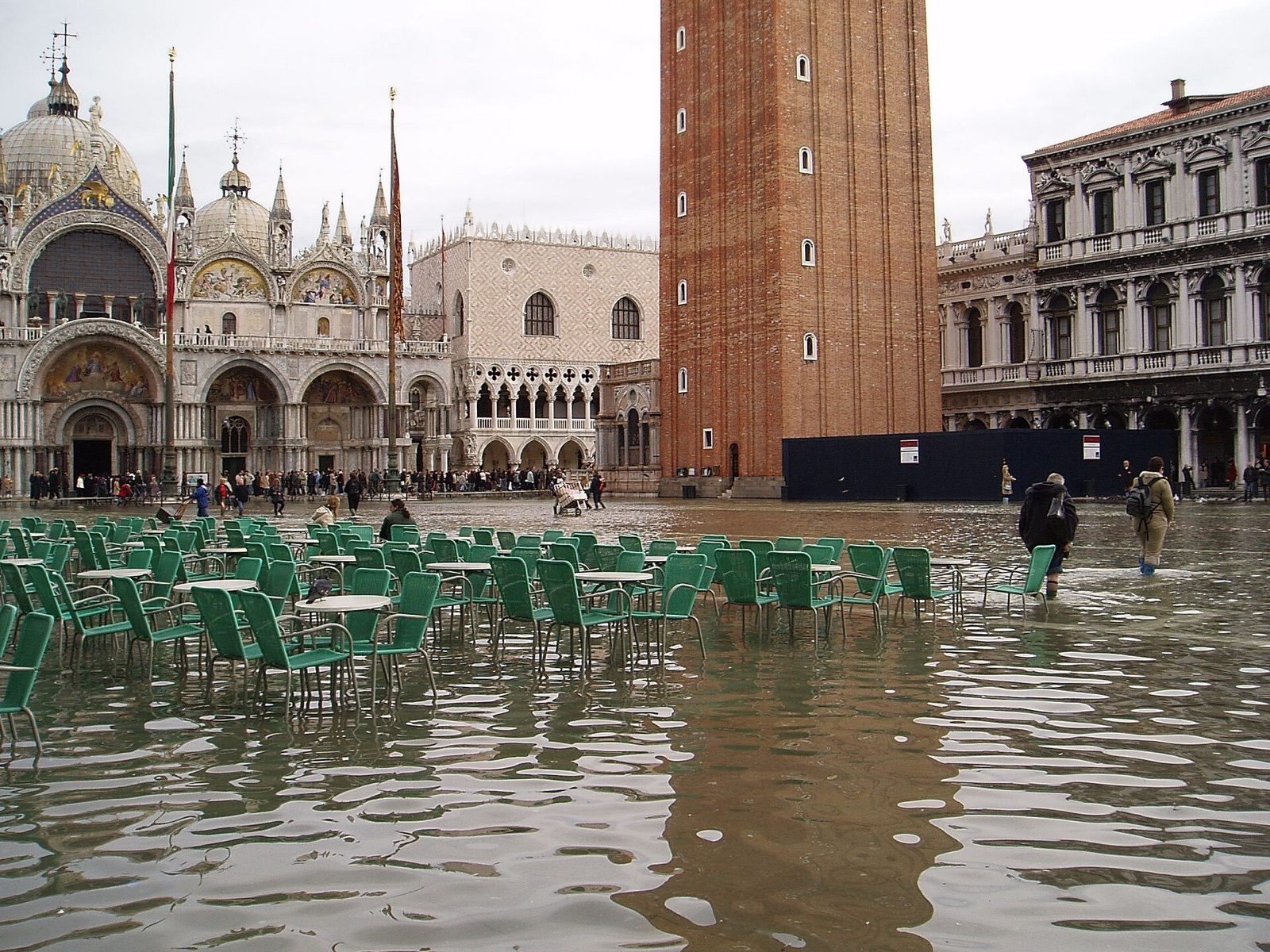
Ground Truth
Stand in Piazza San Marco on the wrong morning and you watch the floor fill from underneath. The water does not pour in from the canals. It rises through the drains, dark and slow, until the paving stones are a mirror and the duckboards go out. Venetians call it the acqua alta, the high water, and for most of the city's history there was nothing to be done about it except lift the furniture and wait.
The reason is the lagoon itself. Venice sits in a shallow basin of brackish water, roughly fifty kilometres long, cut off from the open Adriatic by a thin chain of sandbars. Three gaps break that chain, the inlets at Lido, Malamocco and Chioggia, and through them the sea breathes in and out twice a day. Most tides come and go without comment. Trouble arrives when a high spring tide lines up with the sirocco, the warm southern wind that runs the length of the Adriatic and shoulders the water north until it has nowhere to go but up and into the lagoon. Low pressure lifts the sea a little further. The basin fills.
San Marco floods first because it is the lowest doorstep in the city, one of the first squares to go under long before the rest. A tide that barely wets the outer islands can leave the basilica standing in several centimetres of Adriatic.
The sea here was never kept out. It was let in, twice a day, for a thousand years. What is new is the switch.
That switch is MOSE, seventy-eight steel gates laid flat on the seabed across the three inlets. At rest they lie flooded and out of sight, part of the channel floor. When a dangerous tide is forecast, compressed air is pumped in to push the water out, and the gates pivot up on their hinges until they stand shoulder to shoulder above the surface, a temporary wall sealing the lagoon from the sea. Raising the barriers takes about half an hour. The system first held the tide back from the city on 3 October 2020.
It is used more than anyone expected. The gates go up when the forecast passes roughly 110 centimetres above the old Punta della Salute mark, and in the 2025 to 2026 season they closed the inlets around forty-nine times, the most in any year so far. There is a catch the engineers knew about from the start. Below that threshold the lowest ground still takes on water, so San Marco can flood on a tide too small to justify sealing a working port. For now Venice lives between the two numbers, reading the sky, and deciding each morning whether to let the sea in or keep it at the door.