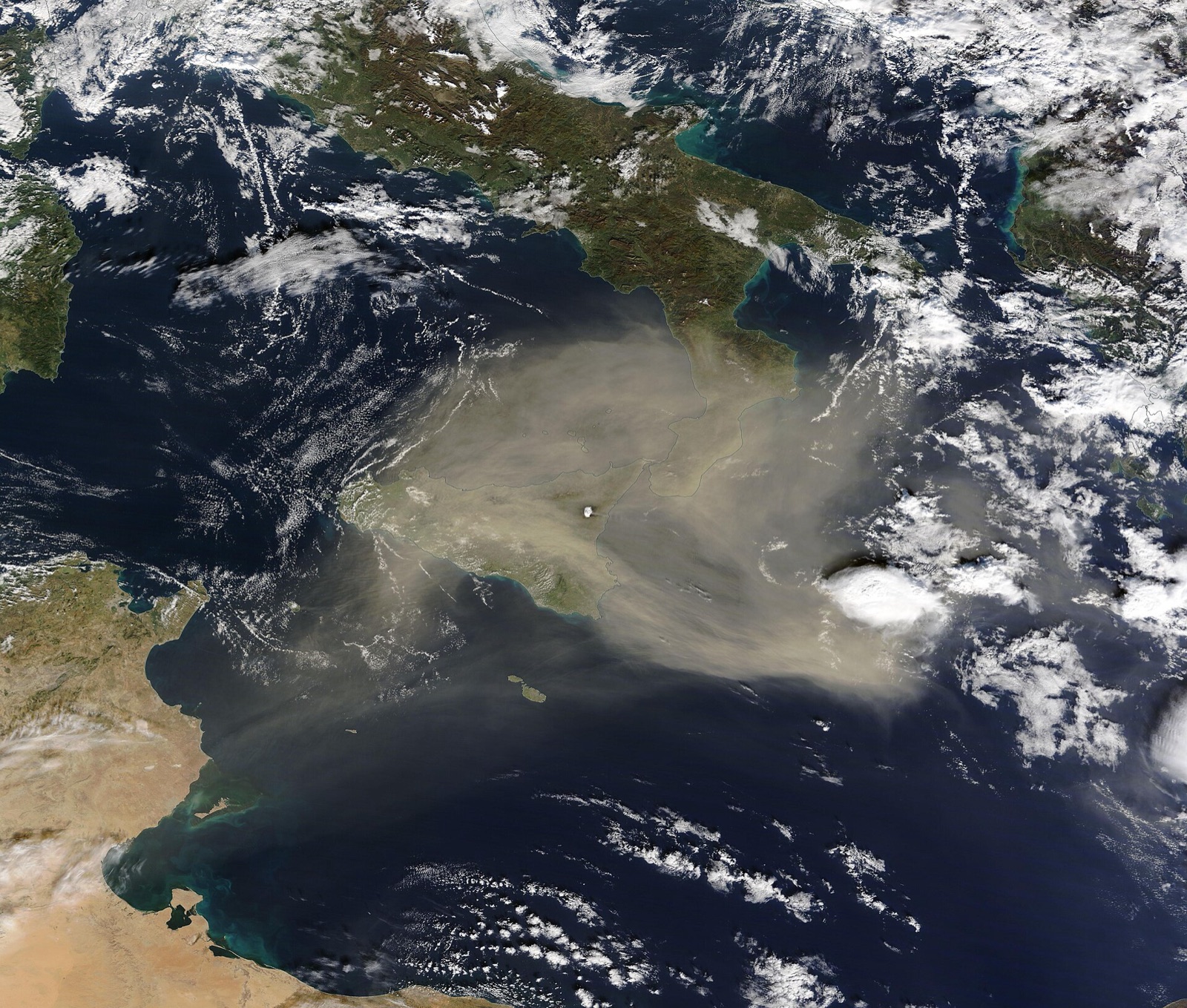
Ground Truth
A hot wind off the Sahara that crosses the sea, coats Sicily and Malta in red dust, and leaves most of what it passes a little short of temper.
Spend a week on the south coast of Sicily in high summer and you will meet it. The morning starts clear. By noon the light has gone the colour of weak tea, the sea flattens, and the air arrives already warm, as though the day had been breathing on you before you woke. This is the sirocco, and it does not come from the mountains behind you. It comes from Africa.
The cause sits a long way south. A low-pressure system tracks east across the Mediterranean and drags warm, dry air up out of the Sahara, over Libya and Tunisia, and out across open water toward Sicily, Malta and the Italian mainland. It is not one nation's wind, so it answers to many names. Ghibli in Libya, khamsin in Egypt, where the word means fifty, for the run of days it can hold in spring, xlokk in Malta, jugo along the Croatian coast, scirocco in Italy. It gusts to a hundred kilometres an hour, peaks in March and November, and can pass in half a day or lean on a place for the better part of a week.
What leaves the desert dry does not stay that way. Crossing the sea the wind takes up moisture off the surface, so the air that hit Libya as a furnace reaches Sicily thick and humid, the kind of heat that makes cloth cling and stone sweat. It also carries what it lifted on the way. When that dust meets rain over southern Italy it falls as blood rain, a reddish wash that films cars, balconies and washing lines and settles into the pale limestone of Sicilian and Maltese towns until someone hoses it off.
The sirocco is not weather that happens to the central Mediterranean. It is the Sahara, arriving in person and expecting to be felt.
It gets into people, or the story says it does. Along its whole path there is an old habit of blaming the wind for short tempers, ragged sleep and a general unease, the sort of mood you would rather hang on something outside yourself. The dust is less forgiving. It works into hinges and engines and the seams of buildings, and the red haze that swallows the horizon is the same grit that ends up on the sill.
So read it the way the locals do. When the sky yellows and the sea goes still, take the shaded side, drink more water than you think you need, and leave the white shirt in the bag. The sirocco passes. What it leaves behind, a fine red skin over everything, is the desert reminding a set of islands how close the other shore really is.
One selection at a time, in your inbox. Subscribe →