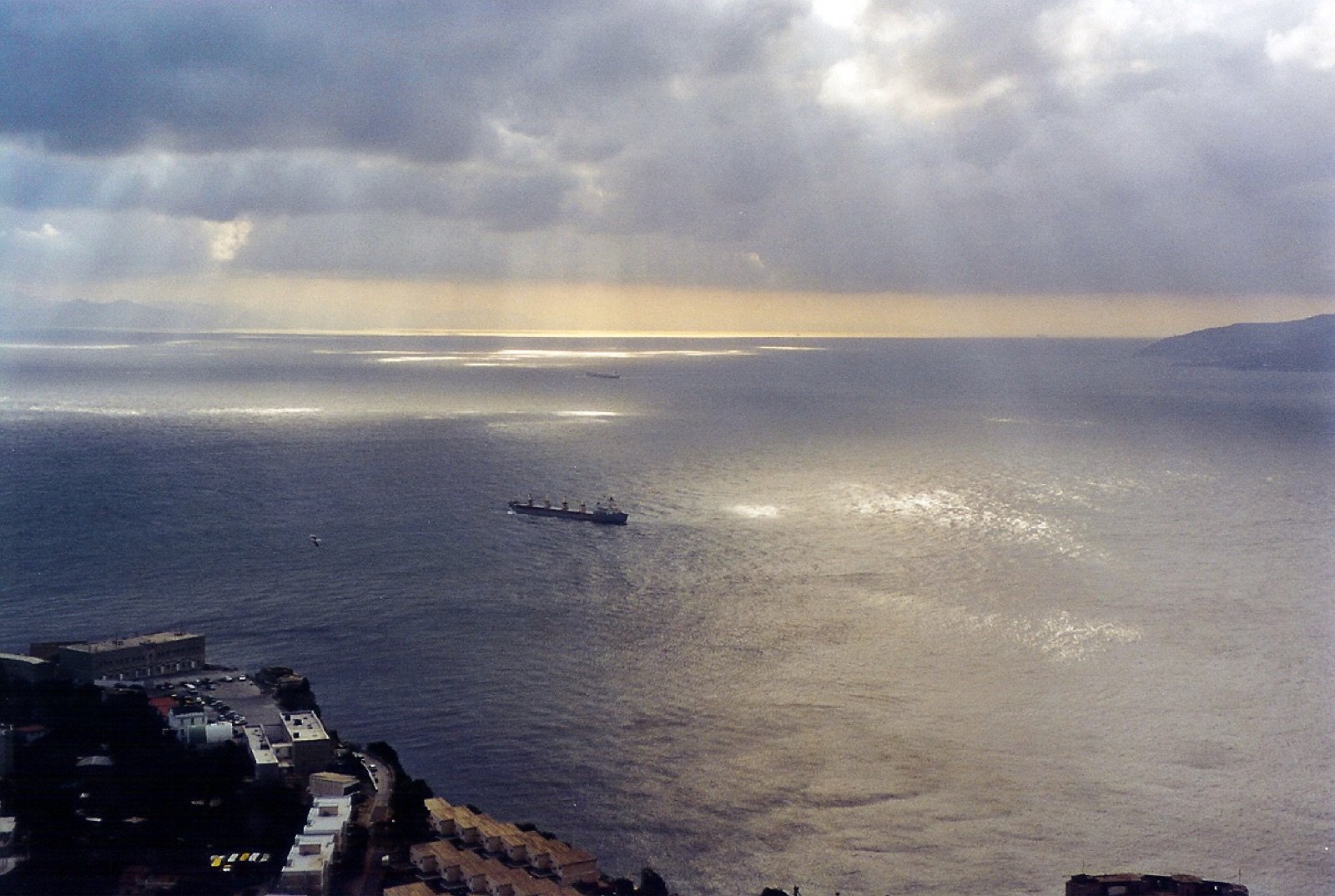
Ground Truth
We have crossed it by ferry more than once, Tarifa to Tangier, the whole passage done before a coffee cools. Two continents sit close enough here to read the weather on the far side. Roughly fourteen kilometres of water at the narrowest, between Point Marroqui in Spain and Point Cires in Morocco. It looks like a gap in a map. It behaves like a valve.
The ancients understood the drama of the place better than the width suggests. This was the edge, the Pillars of Hercules, the Rock on one shore and an African summit on the other marking where the known world stopped and the outer ocean began. Ships that passed were leaving the map, and for a long time the advice was not to.
What they could not see is the machinery. The Mediterranean loses more water than it takes in. The sun lifts more off its surface each year than every river, every storm, every mouth of the Nile and the Rhone can pour back. Sealed off, the sea would fall and thicken into brine. Gibraltar is the reason it does not. Through that narrow gate the Atlantic comes in at the surface, warmer and fresher, a current that has pushed against sailors for as long as there have been sailors to push.
A sea this blue is not a still thing. It is a slow machine, and this strait is the intake.
Underneath, the traffic runs the other way. Denser, saltier Mediterranean water slides out along the bottom, a deep river flowing west into the Atlantic. Two seas exchanging water in opposite directions at once, one stacked over the other. Oceanographers call the lower stream the Mediterranean Outflow. For centuries sailors felt only the top one, and cursed it.
We know the alternative, because it has happened. Between roughly 5.96 and 5.33 million years ago the connection closed, and the basin did what an unfed evaporative sea must. It dried. The Messinian salinity crisis left salt flats far below the old shoreline, a white waste where Crete and Sicily now stand in deep water. Then the gate gave way. The Atlantic came back in the Zanclean flood, refilling the whole basin around 5.33 million years ago at a speed nothing since has come close to.
So the postcard owes everything to fourteen kilometres of contested water that most travellers cross without once looking down. Every glass of this sea has passed the gate, or is waiting its turn. Stand at Tarifa with the wind up and you can sense the surface running east, the Atlantic quietly feeding a sea that would otherwise vanish. The quietest border in the Mediterranean, and the one that holds it together.
One selection at a time, in your inbox. Subscribe →