Ground Truth
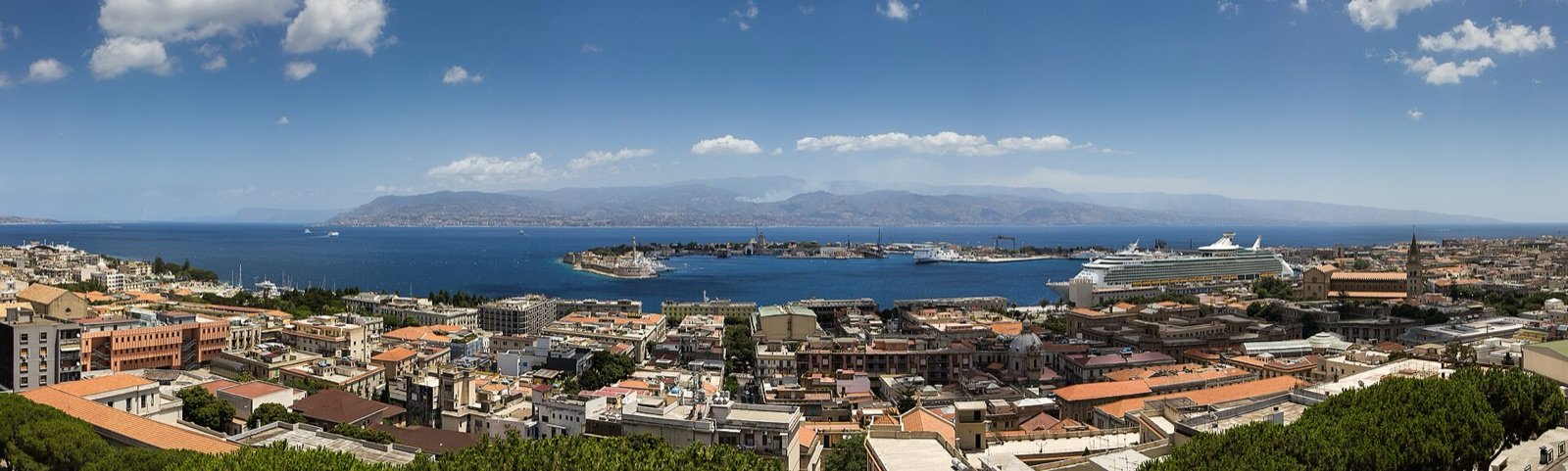
We have crossed the Strait of Messina at slack water, when the sea lies flat and innocent, and we have crossed it two hours later, when the same stretch heaps up into standing ridges and the ferry corrects its heading against a push it cannot see. Three kilometres of open channel separate Sicily from the toe of Calabria. Homer put two monsters in it. He was not wrong to.
The narrowest gate, between Torre Faro on the Sicilian side and Villa San Giovanni on the mainland, is 3.1 kilometres wide. Through it the Tyrrhenian Sea to the north meets the Ionian to the south, and the two do not keep the same clock. Their tides run roughly out of phase, so that one basin is filling while the other empties. Water always seeks its own level. Here it can only find that level by pouring through the strait, and it pours hard.
The result is a current that reverses about every six hours, four times a day, with a brief hush between each turn. On spring tides it reaches four to five knots at the narrows, over open water hundreds of metres deep. Sicilian fishermen have names for the two directions, the rema montante that sets north towards the Tyrrhenian and the rema scendente that sets south towards the Ionian, and they read the change of the tide the way a farmer reads a sky.
This is not weather. Weather passes. The strait keeps its appointment four times a day, on the moon's timetable, and has done so since long before anyone gave its whirlpools names.
Charybdis is the whirlpool, and she still forms, off Capo Peloro on the Sicilian shore, where the outflowing current tears at the seabed and folds back on itself. Across the water, on the Calabrian cliff, the rock of Scilla holds down the other half of the story. Odysseus was told to hug Scylla and lose six men rather than gamble the whole ship on the pool. Read plainly, it is navigational advice dressed as prophecy: keep to the deep side, accept the smaller loss, do not let the current take you.
There is a stranger gift in all that churning. The reversing flow drags cold, deep water up to the surface, and with it come animals that have no business in daylight. After a hard turn of the tide, people along the Ganzirri shore have found Sloane's viperfish and other creatures of the abyss lying on the shingle, far above the black water where they belong. The swordfish boats work the same upwelling their grandfathers did, long spotting masts and a gangway thrown out over the bow, hunting fish that the strait itself has pushed towards the light.
Engineers have been promising a bridge across this water for sixty years, and the plans are live again. Whatever finally gets built above it, the strait underneath will keep turning on its six-hour clock. That much it decided a long time ago, and it has never once been asked.
One selection at a time, in your inbox. Subscribe →