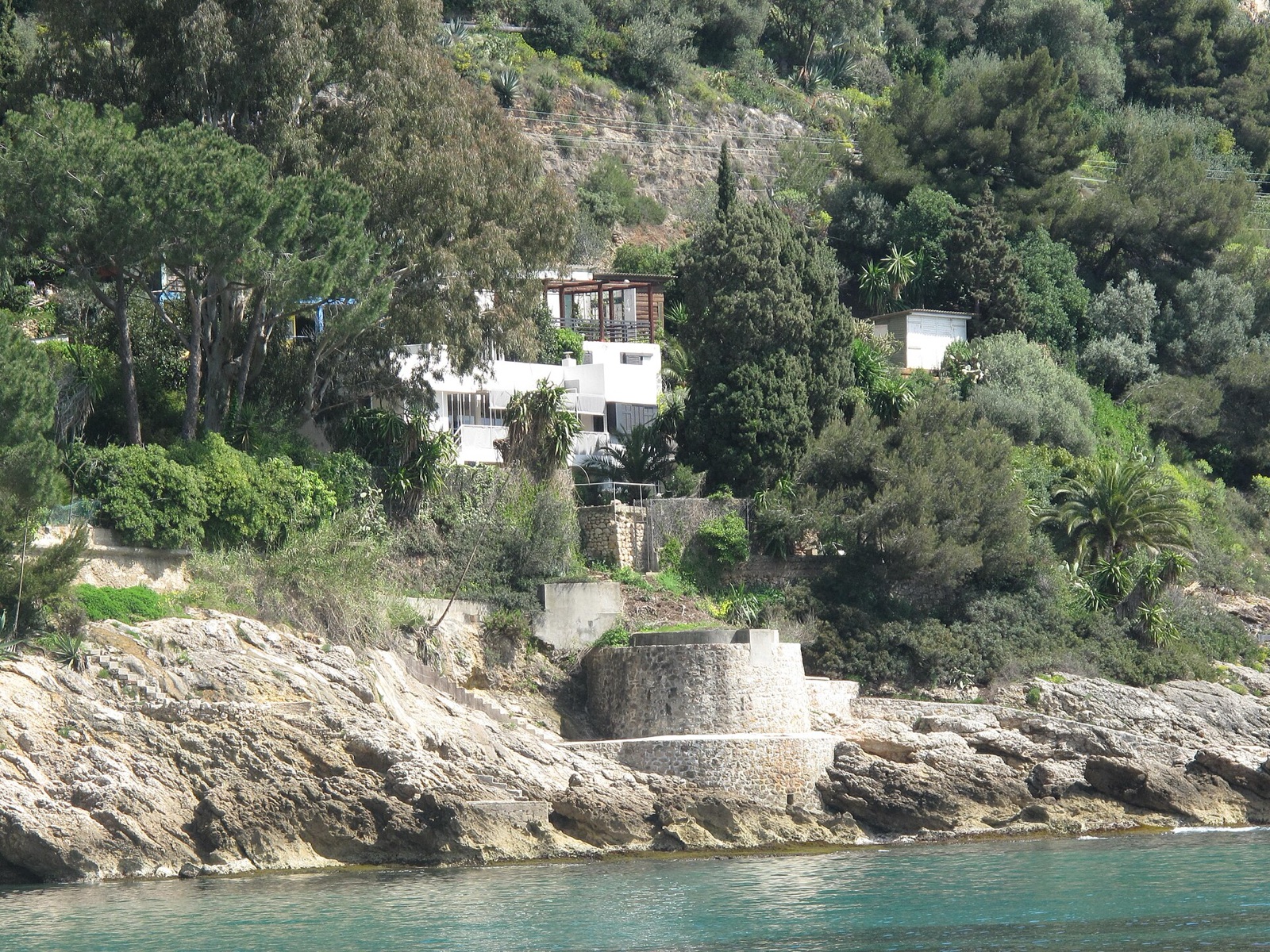
There is a path below the little railway halt at Roquebrune-Cap-Martin that switches back down through pine and agave to a ledge above the water. Within a few hundred metres of each other stand some of the most argued-over buildings of the twentieth century. They are close enough to see one from the next, and far enough apart in spirit to have kept two architects at odds for decades.
The ensemble is now cared for as Cap Moderne and opened by guided tour. We would book well ahead and go early, before the sun turns the rock white. Here is what to look for, and in what order the story unfolds.
- Villa E-1027. Eileen Gray built this white, ship-like house between 1926 and 1929, with and for the architect Jean Badovici. The cryptic name is a cipher of their initials. Gray designed the furniture and the fittings as one idea, and the result was read at once as a landmark of the modern movement. Restored over years of effort, it is open again to visitors who move through it in small numbers.
- The murals. In 1938 and 1939 Le Corbusier, a guest here, painted eight murals directly onto Gray's white walls, without her consent. She saw it as an act of defacement, and the critical argument over whether it was homage or vandalism has never quite settled. Look at them knowing the house was designed to have none.
- The Cabanon. A few steps up sits Le Corbusier's own retreat of 1952, a timber cabin just 3.66 metres square, its every dimension drawn from his Modulor system. He built it as a gift for his wife, Yvonne, and called it a castle. Fifteen square metres hold a bed, a table, a basin and a place to work. It is the smallest thing he ever made, and one of the most quoted.
- The camping units. Leaning against Thomas Rebutato's little bar, L'Etoile de Mer, are five painted cabins Le Corbusier drew for his friend and put into use from 1957. They were an experiment in the minimum holiday dwelling, plywood boxes for the seaside. The Cabanon and these units carry the 2016 UNESCO listing of his work; E-1027, by Gray's hand, does not.
- The water below. On 27 August 1965 Le Corbusier walked down to this shore, swam out against his doctor's advice, and did not come back. His body was recovered from the sea beneath the cliff he had claimed with paint and a cabin. Stand on the rocks at the foot of the path and the whole quarrel, the house and the intruder both, sits in a single frame.
I have a castle on the Cote d'Azur that measures 3.66 metres by 3.66 metres. It is for my wife, and it is extravagant in comfort and kindness.
Le Corbusier, on the Cabanon
The Edit is a VANE Bearings column. We choose the way we choose hotels, on our own terms, with no placement bought. Photo: Tangopaso, Wikimedia Commons (Public domain).
← More from Bearings