Ground Truth
We came to Malta in a flat calm, the Grand Harbour the colour of tin, and a man mending nets on the Vittoriosa quay told us to come back in January if we wanted to understand the place. That is when the Gregale arrives. The word is simply the Maltese ear for the Greek, the wind out of the northeast, and on this island it is less a weather report than a piece of local character.
The mechanics are plain enough. A low pressure system slides across the central Mediterranean and settles to the south of Malta. Air pours in behind it from the northeast, cold off the Balkans, and funnels down the Ionian Sea with nothing to slow it. By the time it reaches the island it is a hard, dry gale that can hold gale force for three or four days and push the sea to more than forty knots. It is a winter wind above all, and it does not bluster. It leans.
Geography did Malta no favours here. The great harbours on the northeast coast, the Grand Harbour and Marsamxett either side of Valletta, open their mouths in exactly the direction the Gregale comes from. For centuries a strong blow meant a following sea driving straight through the harbour entrance, and galleys, then merchantmen, then ferries riding it out with everything they had.
The wind is old enough to be scriptural. Sailors long identified the Gregale with the Euroclydon of the Book of Acts, the tempest that drove Paul's ship for a fortnight before it broke apart on a Maltese shore. Fourteen days is a long time for any Mediterranean storm. Whatever the theology, the seamanship rings true.
You do not argue with the Gregale. You build a wall and wait for it to lose interest.
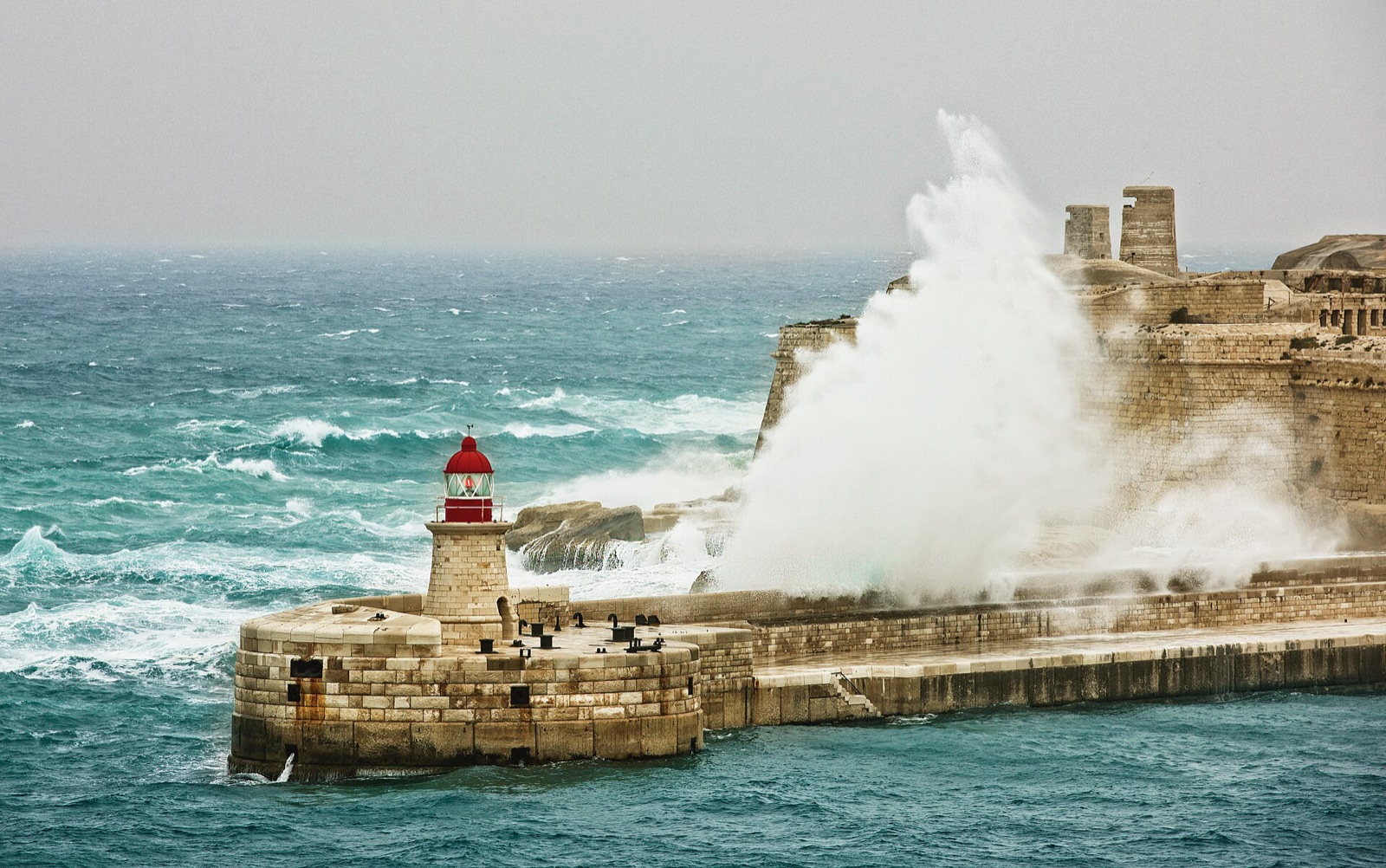
So Malta built the wall. In 1903 King Edward VII laid the foundation stone of a great breakwater across the mouth of the Grand Harbour, two stone arms reaching out from Fort St Elmo and Ricasoli to break the northeast sea before it entered. The English firm of S. Pearson and Son did the work, and it opened around 1910. The longer arm runs some 378 metres, deliberately left clear of the shore so the water behind it would not stagnate. More than a century on it still takes the first blow.
It has not tamed the wind. When the Gregale is up the ferries to Gozo still stop, the harbour pilots still wait, and the spray still comes clean over the breakwater in white sheets. That is the honest thing about a place shaped by weather. The engineering buys you calm water, not calm air. Come in January and watch the sea test the wall, and you will read the island the way the man mending nets meant you to.