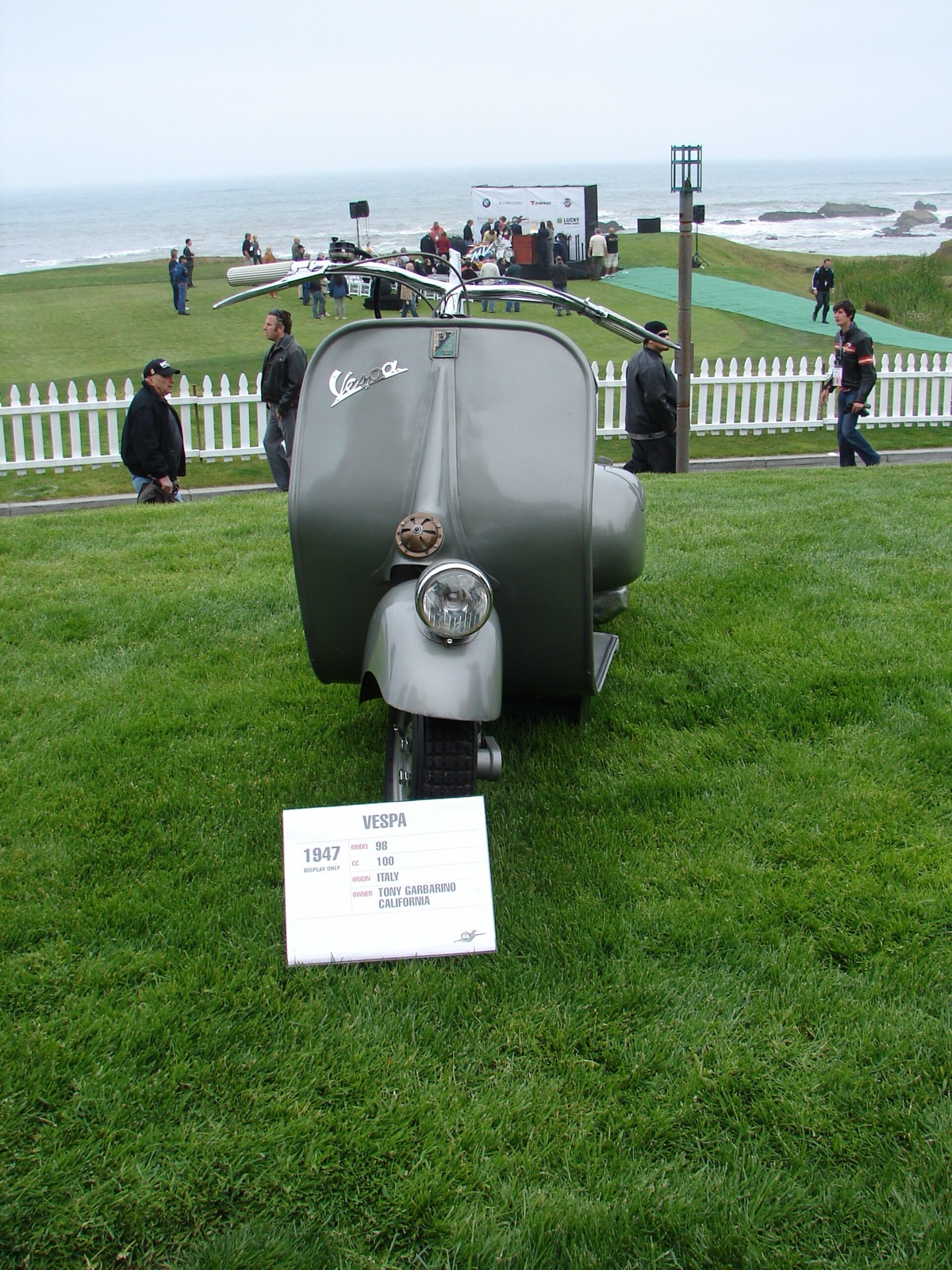
The Object
On 31 August 1943 the Piaggio works at Pontedera, in the flat Tuscan country between Pisa and the sea, were bombed flat. The company had built seaplanes and bombers. What it had after the war was a wrecked plant, a broke country and roads full of people who could not afford a car and had nowhere near enough petrol for one anyway.
Enrico Piaggio wanted a cheap machine that anyone could ride, and he handed the problem to Corradino d'Ascanio, an aeronautical engineer who had worked on helicopters and disliked motorcycles. He thought them filthy, awkward, and impossible to mend at the roadside. So he refused to design one. Instead he brought the logic of an aircraft to the street.
The frame was a load-bearing steel body rather than a cat's cradle of tubes, so there was no oily bar to swing a leg over. He hung the engine beside the rear wheel, which meant a punctured tyre came off like an aeroplane's rather than a bicycle's. He put a shield at the front to keep the rider's trousers clean. A woman in a skirt could sit and ride without ceremony. That, more than the engine, was the invention.
It was built by a man who hated motorcycles, which is exactly why it was nothing like one.
Enrico Piaggio looked at the finished prototype, with its narrow waist and swollen back and its thin two-stroke buzz, and said it looked like a wasp. Vespa. The name went on the tank and never came off.
The design was patented on 23 April 1946. It had already appeared on the cover of the magazine La Moto on the fifteenth of that month, and the first model, the Vespa 98, carried a single-cylinder two-stroke of 98cc making a little over three horsepower. It was slow, it was loud on a hill, and it sold out.
What followed is the part everyone remembers. The Vespa put a whole generation on wheels who had never expected to leave their own town, and it did it with a shape so complete that it has barely changed in eighty years. Rome learned to flirt on one. The films came later and borrowed the freedom that was already there.
We tend to think luxury is the thing that costs the most. Now and then it is the opposite: an object so well made that it turns scarcity into style, and asks almost nothing of you in return. The little wheel from Pontedera still does.