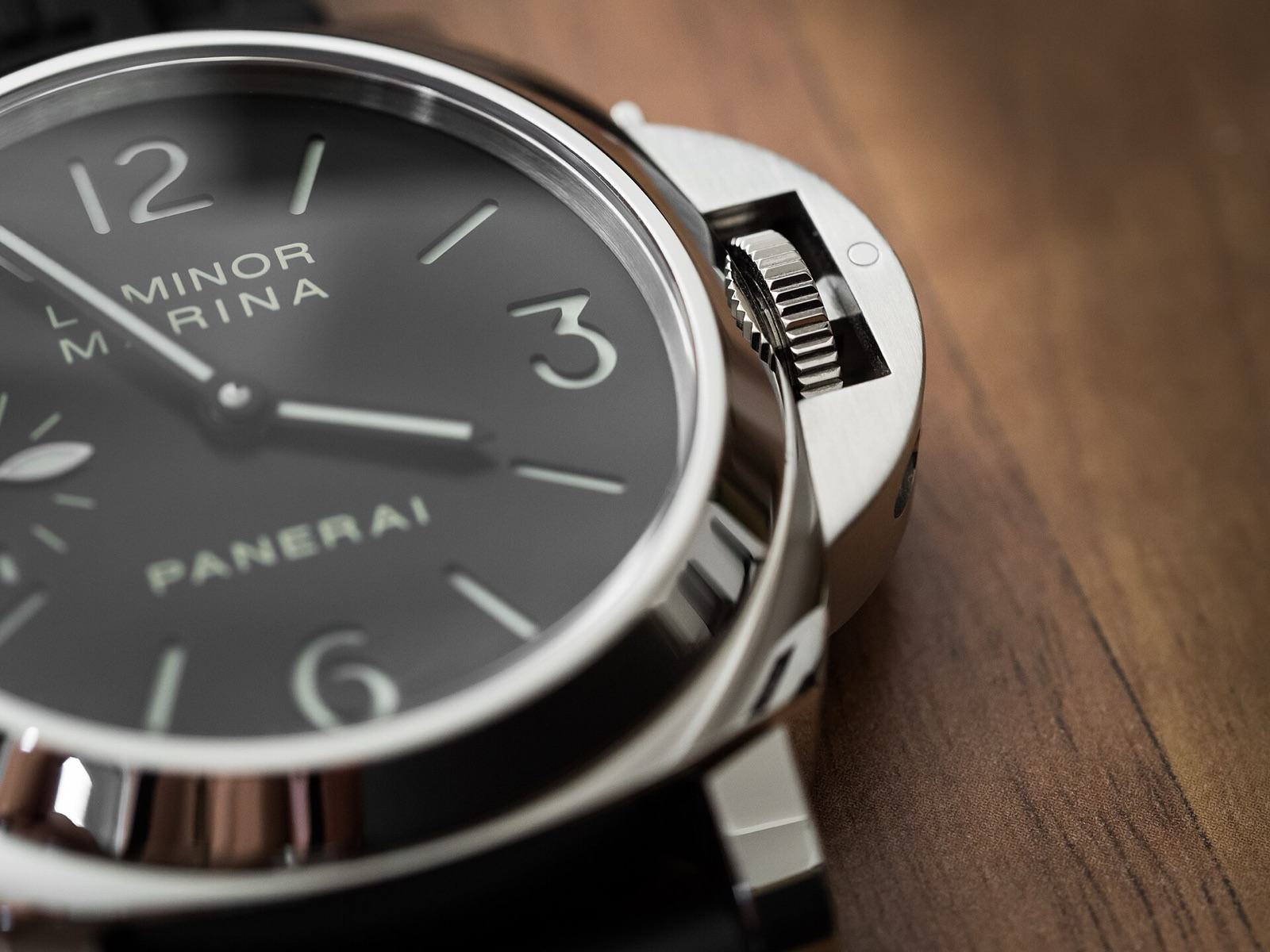
The Object
We have handled a good number of watches that claim a naval past, and most of the time the claim is thinner than the marketing around it. The Luminor is one of the few whose shape was genuinely dictated by men going into cold water with a job to do. You feel it the moment you pick one up. Nothing about it was drawn to look good on a poster.
The story starts in Florence in 1860, when Giovanni Panerai opened a watch shop and repair bench by the Arno. For decades the firm was the quiet supplier of precision instruments to the Regia Marina, the Italian royal navy: compasses, depth gauges, the unglamorous kit a fleet runs on. In the middle of the 1930s the navy came back with a harder request. Its combat divers, the frogmen who rode manned torpedoes into enemy harbours under the cover of night, needed a watch they could read at depth, in the dark, through a fogged mask.
The first answer was the Radiomir, built on cases supplied by Rolex and coated in a radium-based paint Panerai had patented back in 1916. It glowed. It also, in time, proved to be exactly as radioactive as it sounds. The fix arrived in 1949 with a new luminous compound the firm named Luminor, this one based on tritium and a good deal safer to strap to a wrist.
The watch we recognise now came together in the years that followed, and its defining feature was patented in Italy in 1955: the crown-guard bridge. It is that half-moon lever on the right flank of the case, a small clamp that presses the winding crown down against its gasket and locks it there. A diver could feel it seat with a thumb. It made the case watertight without a screw-down crown, and it gave the Luminor a silhouette no other watch has ever managed to borrow without looking like a copy.
Everything about it was solved with a purpose, and the purpose has outlived the war that set it.
The cushion case was drawn oversized on the same logic. A large dial with fat luminous numerals is a legible dial, and legibility, not elegance, was the brief. For half a century almost nobody outside the navy knew any of this existed. Panerai made these things in tiny numbers for a single client and kept quiet about it.
Then the 1990s happened, the archive opened, and a wrist that had belonged to secret swimmers turned up on half the film stars in Europe. We rather like that the watch never changed to suit them. The bridge still clamps the crown. The numerals still glow. It is a piece of the Mediterranean's cold-water history that you can still buy new, doing the one thing it was drawn to do.